
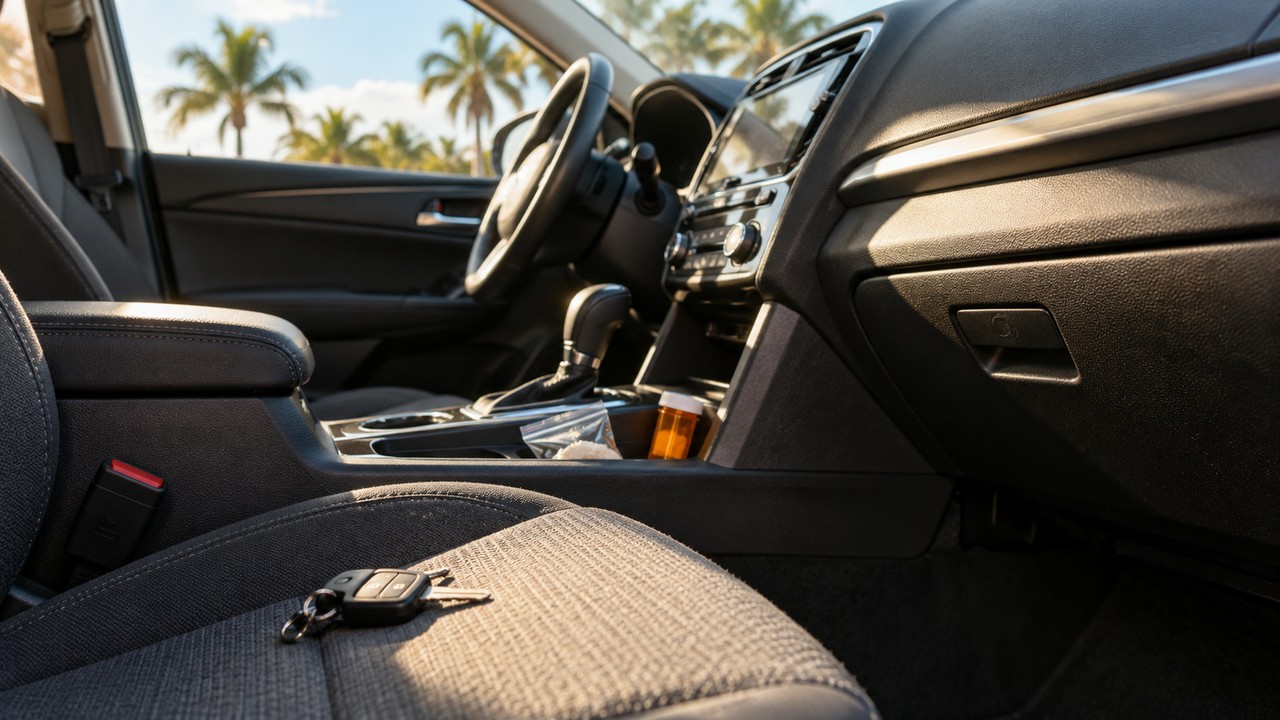
Being Near Drugs Isn’t the Same as Possessing Them Under Florida Law
Drug possession charges in Florida don’t always involve drugs found in someone’s pocket. Riding in a friend’s car or sharing an apartment with a roommate might feel like a part of ordinary life. But a bag of pills under a car seat or a sofa can lead to felony charges against people who never touched it or even knew it was there.
Florida’s drug law reaches beyond what a person carries. Florida Statute Section 893.13 bans “actual or constructive possession” of a controlled substance without a valid prescription. Constructive possession means the drugs weren’t on the person. Instead, prosecutors claim the person knew the drugs were there and could control them.
That distinction can make a dramatic difference in the outcome of a case. Our Clay County drug possession lawyers at Aguilar & Sieron, P.A. have seen firsthand how these charges are sometimes built on assumptions rather than proof. Being close to drugs isn’t the same as possessing them. So what does the state have to prove? And how can someone fight back when the drugs belonged to someone else?
|
At a Glance
|
What Does Constructive Possession Mean in Florida?
Possession comes in two forms. Actual possession means the drug is in someone’s hand or pocket. Constructive possession covers drugs found somewhere else, such as a glove box or a bedroom closet. The state can file this charge even if the person never handled the drugs.
Florida’s Standard Jury Instruction 25.7 tells jurors how to weigh these cases. The state must prove two things. First, the person knew the substance existed. Second, the person intentionally exercised control over it. Control can mean the power to decide what happens to the drugs.
The instruction also warns that simply being near drugs doesn’t prove control without more evidence. That matters in tight spaces like cars and shared homes. Prosecutors use the same theory in drug trafficking cases, where larger amounts can trigger mandatory prison sentences. The weight of the drugs, not who held them, often sets the charge.
The difference between the two types of possession shapes how prosecutors build a case and where a defense can push back.
| Actual Possession | Constructive Possession | |
|---|---|---|
| Where the drugs are | On the person, such as in a hand or pocket | Somewhere nearby, such as a console, closet, or bag |
| What the state relies on | Direct physical evidence | Circumstantial evidence linking the person to the drugs |
| Shared spaces | Usually not an issue | Closeness alone isn’t enough without independent proof |
| Common defense angles | Unlawful search or stop | Shared access, no forensic link, or an unlawful search |
How Do Prosecutors Link Someone to Drugs They Weren’t Holding?
When drugs turn up in a shared car or home, officers start looking for anything that ties one particular person to them. The evidence gathered in the first hours after a search often decides whether prosecutors charge one person, two people, or nobody at all.
- Personal Belongings Nearby – Mail, a wallet, or an ID card sitting beside the drugs can suggest that a specific person controlled that space.
- Statements to Police – Comments made during a traffic stop or search, even offhand ones, can become key evidence tying a person to hidden drugs.
- Control of the Car or Home – Driving the car or signing the lease can matter. But when others share the space, that fact alone usually falls short.
None of these links works as automatic proof. A wallet near a backpack shows where someone set down a wallet. It doesn’t prove that person knew what was zipped inside the bag. Each claimed connection deserves a hard look for gaps in timing, access, and testing. Strong defense work often starts right there.
Why Does It Matter Who Else Was in the Car or Home?
Florida courts treat shared spaces differently. When two or more people share a car or apartment, courts won’t infer knowledge from closeness alone. In those cases, the state needs independent proof. That means separate evidence, beyond where the drugs sat, showing the accused knew about them and could control them.
A 2018 case from Florida’s First District Court of Appeal, which hears Clay County appeals, shows how this works. In Jones v. State (No. 1D17-2808), troopers found cocaine in the closed center console of a rental car. The driver admitted the marijuana on his seat was his. He denied knowing about the cocaine.
The appeals court reversed his cocaine conviction. His passenger had sat alone in the car for about nine minutes while troopers waited for a drug dog. The state never tested the baggie for fingerprints or DNA. It also never showed who used the rental car before him. Even his nervous behavior didn’t count as proof.
Does Knowing Drugs Were There Make Someone Guilty?
Knowledge alone doesn’t finish the state’s case. A passenger who notices a friend’s pills in a cupholder knows they’re there. That passenger may still have no power or intent to control them. Jurors must find both knowledge and control beyond a reasonable doubt, the highest standard of proof in our legal system.
There’s a twist many people don’t expect. Under Florida Statute Section 893.101, prosecutors don’t have to prove a person knew a substance was illegal. Lack of that knowledge works as an affirmative defense instead. That means the accused raises it and offers evidence to support it.
That defense differs from not knowing drugs were present at all. Knowledge of the drugs’ presence remains part of the state’s burden in every constructive possession case. So someone who had no idea pills were hidden in a borrowed jacket can challenge the charge head on.
What Defenses Can Challenge a Constructive Possession Charge?
These cases often rely on circumstantial evidence, meaning facts that point toward guilt without directly proving it. That leaves room for a defense built around the holes in the state’s story, with several approaches that can apply depending on the facts of each arrest and search.
- Shared Access – Proof that roommates, passengers, or earlier drivers could reach the area may undercut any claim that one person controlled the drugs.
- No Forensic Link – Missing fingerprint or DNA testing can leave the state without physical evidence tying the accused to the drugs or packaging.
- Unlawful Search – If officers searched a car without a warrant, consent, or another legal basis, a judge may throw out the evidence.
Each defense depends on the details of the stop or search. Body camera footage, rental agreements, and witness statements can show who had access and when. That evidence doesn’t last forever. Businesses and landlords may not keep records or video for long, so early investigation can protect evidence that shows who controlled the space.
Turning the Small Details Into Your Defense
If police found drugs in a car or home you shared, you may face a felony charge for something you never held. Constructive possession cases in Clay County often turn on small details. Who drove the car last? Who signed the lease? Did anyone test the evidence? Those answers can change your case.
Our Green Cove Springs drug defense attorneys at Aguilar & Sieron, P.A. have defended people throughout Northeast Florida for more than 40 years. Attorney Mark Sieron is a former prosecutor. As a result, he knows how the state builds these cases. That helps us spot weak links early and build strong legal cases based on solid evidence.
Your freedom matters. So does every detail in the police report. Contact us for a free consultation so we can review the search and explain your legal options. We’re available 24 hours a day, seven days a week, and our office sits right next to the Clay County Courthouse.
“Mr. Sieron, I thank you from the bottom of my heart for the legal services you provided for me and my family. You worked a miracle and really saved my life.” – T.B., ⭐⭐⭐⭐⭐